Scope of state governments draws national budget concerns
Warning: Undefined array key 0 in /home2/cityrevi/public_html/wp-content/themes/_city/single.php on line 65
By Sheila Ponnie
The civil society organizations have raised concerns over the vast size of the recently established state and local governments in a move to finalize the Revitalized Agreement on the Resolution of the Conflict in South Sudan.
The concerns emanated last week Monday after the Minister of Information announced that signatories to the peace process agreed on the responsibility sharing ratio at state purview.
The agreement entails that the parties nominate ten Deputy Governors with the Incumbent Transitional Government of National Unity, the SPLM-IO, and Other Political Parties submitting three nominees each, while South Sudan Opposition Alliance takes one deputy gubernatorial seat.
As dictated by R-ARCSS article 1.16, the responsibility of power-sharing ratio at the state and local government of the Incumbent TGoNU shall have 55%, SPLM/A-IO 27%, South Sudan Opposition Alliance 10%, and Other Political Parties with 8%
However, signatories to the agreement resolved to appoint 17 ministers on the deal of the responsibility of sharing the executive portfolios with five advisors for each of the ten states.
Against that backdrop, the SPLM-IO shall nominate three advisors, SPLM-IO one, and South Sudan Opposition Alliance shall retain a slot.
The new government also doled out ten states speakers of parliament, with five from the former government, three from SPLM-IO, one from SSOA and OPP respectively. There shall be two chief whips per state, one appointed by the former government and one by the SPLM-IO.
With 51 members of parliament in the 10 states agreed, President Kiir shall appoint 28, Machar shall nominate 14, while SSOA shall nominate 5 and OPP with 4 MPs.
The parties also agreed to appoint 35 members of the County Councils, 19 councilors from the former government, nine from SPLM-IO, four from SSOA, and three from OPP.
In a time when the country’s economy was slugging exacerbated by the negative impact of the novel coronavirus, the civil society organizations say the composition of the state administrations was budget-unfriendly.
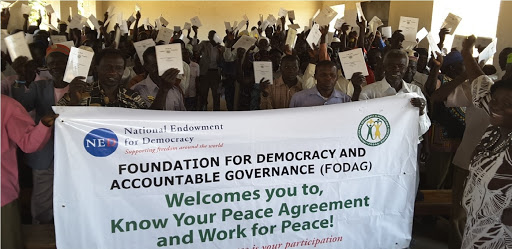
David Jame Kolok, Executive Director, Foundation for Democracy and Accountable Governance said the agreement was a good step taken by the parties and it was a welcomed development except for the seemingly unmanageable structures.
“To us, it is not a very good structure at all, and it is like it’s all about power, privileges, and using the resources for things that are not quite effective other than using the resources for service delivery.
“It is not just going to translate well in terms of service delivery that is the reality because we cannot have this kind of government first of all we already have a very huge parliament being reconstituted. Why have all these huge local government structures?” Kolok questioned.
Edmund Yakani, Executive Director of Community Empowerment for Progress Organization explained that the current size of the state cabinets will be unmanageable without adequate budgets.
“It is a time for the state governors with their officials to focus on service delivery than making personal gains for being in public offices. The national government is required to decentralize and deconsecrate revenue collection and usage. It is time to think of saving people than making personal wealth. Without this political attitude change, the state and local governments will not meet the aspirations of the citizens,” Yakani stressed.
Yakani says his organization will also engage in tracking and reporting the level of state and local governments’ commitment to fighting corruption in its various forms. Yakani urged the state governors to instituted influential and independent state anti-corruption and proper revenue collection mechanisms.
Meanwhile, Wanni Michael, the Executive Director of Okay Africa Foundation said the size of the government will present opportunities for young people who can usher in fresh ideas for the development of the country.
“That will be an opportunity to the young people because in the state governments we expect to see young Deputy Governors, young ministers in the states; we expect to see young commissioners in the states and we are talking about youth both male and female in the Government.
“We are also appealing to the government to increase youth engagement and participation in decision-making processes in especially taking up leadership roles in both local and state levels,” he said.
Hit by COVID-19 and price crash of oil, the main export of the country, South Sudan deferred budget allocation and presentation tentatively scheduled for June this year, to 2021 when the economy begins to take shape.