Trade minister hails upcoming global logistics convention in Juba as hotbed for growth
Warning: Undefined array key 0 in /home2/cityrevi/public_html/wp-content/themes/_city/single.php on line 65
The three-day convention, scheduled for August 25-27, 2026, is expected to bring together logistics experts, freight forwarders, policymakers, investors, and business leaders from across Africa and beyond.
By Emmanuel Mandella
The national Minister of Trade and Industry, Dr. Labanya Margaret Mathya Ugila, has described the upcoming 7th Global Logistics Convention (GLC7) as a strategic opportunity to reposition the country as a regional trade and logistics hub, urging young people and businesses to take advantage of emerging opportunities in trade, innovation, and digital transformation.
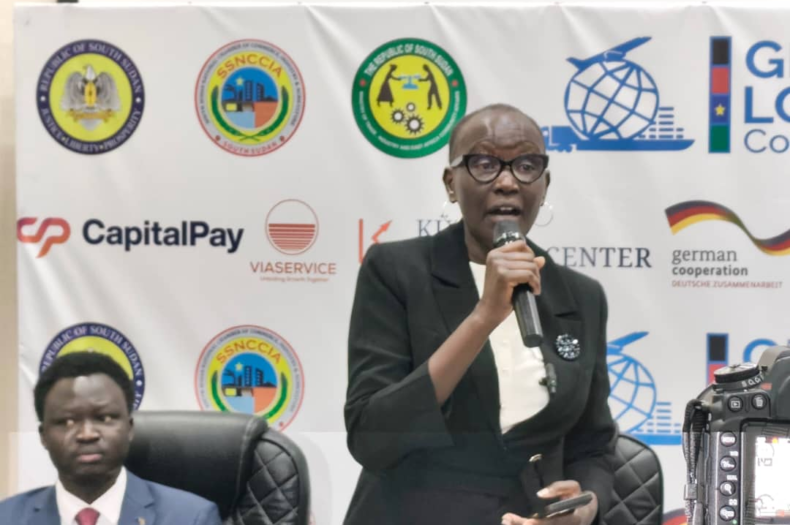
Speaking during the GLC7 Media Launch held Wednesday at Pyramid Continental Hotel in Juba, Dr. Labanya said the convention would not only boost South Sudan’s image internationally but also create opportunities for employment, investment, and regional integration.
The three-day convention, scheduled for August 25-27, 2026, is expected to bring together logistics experts, freight forwarders, policymakers, investors, and business leaders from across Africa and beyond.
“This convention is not only about logistics. It is about creating opportunities for our young people, marketing South Sudan to the world, and positioning our country as a serious player in regional and international trade,” Dr. Labanya said.
The minister underscored the central role trade plays in economic development, noting that South Sudan remains largely dependent on imported goods and must strengthen its trade systems while preparing to expand local production.
“We facilitate trade as a ministry. As we build our production capacity, we must first create an enabling environment that allows businesses to thrive and goods to move efficiently,” she said.
Dr. Labanya described trade as the “great denominator” that connects all sectors of the economy, including energy, taxation, manufacturing, and transportation.
“Without trade, there would be no exchange of goods and services. Trade is what drives economic activity and links all sectors together,” she added.
The minister highlighted the logistics industry as one of the world’s largest employers, particularly for young people, emphasizing that South Sudanese youth stand to benefit significantly from the sector’s growth.
“Logistics is among the greatest employers globally. The movement of goods and services creates jobs, businesses, and opportunities for innovation. This convention should inspire our young people because this is where many future opportunities lie,” she said.
She encouraged youth entrepreneurs to view the convention as a platform for showcasing ideas, networking, and connecting with regional and international markets.
Dr. Labanya also stressed that hosting major international events such as GLC7 helps counter negative perceptions about South Sudan and demonstrates the country’s readiness to engage with global investors and business communities.
“When people come here and see South Sudan for themselves, they discover a different reality from what they often hear. These conventions improve our country’s image, promote confidence, and demonstrate that South Sudan is open for business,” she said.
She noted that the convention would provide an opportunity for the country to showcase its culture, business potential, and entrepreneurial talent.
The minister further called for accelerated digital transformation in trade and logistics, arguing that modern economies can no longer rely on paper-based systems.
“The world is moving towards digital solutions. Trade documentation, customs procedures, and business transactions are increasingly becoming electronic. South Sudan cannot afford to be left behind,” she said.
Dr. Labanya welcomed ongoing efforts to establish One Stop Border Posts and modernize trade procedures, saying such reforms would reduce costs and improve efficiency for traders.
She also emphasized the importance of developing a national postal code system to strengthen logistics operations and facilitate business activities across the country.
“Every location should have a recognizable postal code. This is essential for modern logistics and e-commerce development,” she said.
Touching on broader economic development, Dr. Labanya acknowledged the country’s energy challenges and called for increased investment in renewable energy sources, particularly solar power, while longer-term hydropower projects are being developed.
“Energy is essential for industrialization and trade. While hydropower remains a long-term solution, solar energy provides an immediate opportunity to support businesses and communities,” she said.
The minister used the occasion to invite businesses, policymakers, and development partners to attend the upcoming National Trade Forum, scheduled for Friday and Saturday at Radisson Blu Hotel in Juba.
She said the forum would provide another platform to discuss practical solutions to challenges facing trade and logistics in South Sudan.
As preparations for GLC7 gather momentum, organizers believe the convention could become one of the largest trade and logistics gatherings ever hosted in South Sudan.
For Dr. Labanya, the event represents more than a conference.
“This is an opportunity to sell the ideas of our people, promote the talents of our youth, attract investment, and demonstrate that South Sudan is ready to take its place in regional and global commerce,” she said.
The Global Logistics Convention is organized under the auspices of the Federation of East African Freight Forwarders Associations (FEAFFA) in partnership with the South Sudan Freight Forwarders Association, with support from government institutions and private sector partners.
Utilties
“This is an opportunity to sell the ideas of our people, promote the talents of our youth, attract investment, and demonstrate that South Sudan is ready to take its place in regional and global commerce,” Trade and Industry Minister, Dr. Labanya Margaret.