Sanctions scuttling 2018 peace deal, says Kiir
Warning: Undefined array key 0 in /home2/cityrevi/public_html/wp-content/themes/_city/single.php on line 65
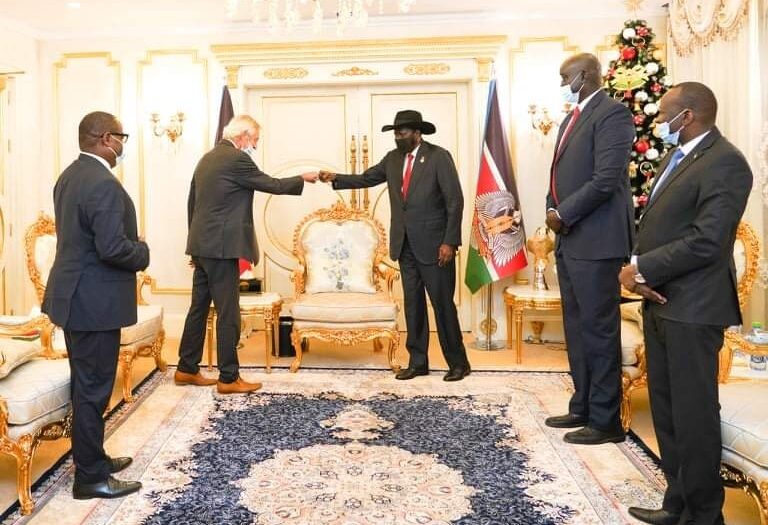
President Salva Kiir has once again faulted the arms embargo imposed by the United Nations Security Council (UNSC), saying it drags the implementation of the Revitalised Agreement on the Resolution of the Conflict in South Sudan.
The President made the statement to the Special Representative to the Secretary-General in South Sudan, Nicholas Haysom, who is expected to travel to New York to address the UNSC next week.
For the third time this year alone, Kiir has called on the international community to lift the sanctions for speedy implementation of R-ARCSS.
According to the statement from the office of the president, Kiir acknowledged the work done by UNMISS and expressed concern about how the sanctions imposed on South Sudan were affecting the implementation of the Revitalised Peace Agreement.
He urged the international community to lift the sanctions to pave the way for the smooth completion of the peace deal.
Haysom discussed the activities of UNMISS in the country with President Kiir and shared notes on his expected briefing to the United Nations Security Council (UNSC) next week.
He promised to raise the issue of the dire humanitarian situation in the country, which has been aggravated by the floods.
Briefing ahead
Haysom also vowed to present the progress made in the signing of the peace agreement but cautioned that he would also mention that it has so far taken a snail’s pace.
“I will highlight the commendable progress made by the parties since the signing of the peace agreement but also note that the pace of implementation remains too slow,” he said in a press briefing on Wednesday
“If this continues, there is a risk that the viability of the broader agreement will come under threat, which is a concern raised by analysts and commentators recently.”
Last month, Kiir blamed the delayed graduation of forces on the arms embargo that has barred the buying and procurement of guns in the country.
He said other challenges delaying the graduation of forces, including the percentage of the composition of the forces and the screening of forces, were just feathers and could be handled by parties.
Kiir argued that the lifting of the arms embargo was an external challenge which, when addressed, all the other challenges dragging the peace process could be sorted out speedily.
“We have repeatedly informed the UN about the negative impact this has on the implementation of chapter two of the agreement, and we have received in return more conditions that do not recognise progress achieved so far,” said Kiir.
“Hence, in the distance, we will have no option other than to graduate these forces with sticks when the other two challenges are resolved, ” he added.
Call to lift sanctions
Last week, Kiir sought the intervention of the International Monetary Fund (IMF) and other international organisations to back up his call to lift the arms embargo imposed on South Sudan by the United Nations.
This was in his virtual meeting with the Managing Director of the IMF, Kristalina Georgieva. Also last month, the President called for the lifting of the arms embargo in his meeting with the United Nations Security Council (UNSC).
“While the agreement’s implementation progresses slowly, I would like to assure your Excellency of my resolve to fully implement it,” Kiir said.
“I equally call upon the IMF and other international organisations to support us on this path by considering the unconditional lifting of the arms embargo and other economic restrictions on South Sudan by our partners.”
Kiir pledged to strive towards the implementation of the Revitalised Agreement on the Resolution of the Conflict in South Sudan (R-ARCSS).
Shunning Graft
Last month, Kiir met with a delegation of the UN Security Council in Juba and stressed that the move would ease the disarming of civilians who claimed they had bought arms and could not surrender them.
He said that when the arms embargo is lifted, the government would buy arms from civilians as the most successful means of carrying out disarmament in the country.
Kiir said disarmament was the only solution to communal conflicts that led to countless atrocities.
Time not ripe
However, the rights organisation, Amnesty International in May warned that the time was not ripe to lift the arms embargo, warning that it could cause dire consequences.
“The Security Council must ensure a range of human rights benchmarks are met before the embargo can be lifted,” reads the report from Amnesty International.
“These include an end to crimes under international law, reform of the National Security Service, and the establishment of a hybrid court to ensure accountability.”