South Sudan launches media-security conference ahead of elections
Warning: Undefined array key 0 in /home2/cityrevi/public_html/wp-content/themes/_city/single.php on line 65

Government officials, journalists and partners push for press freedom and peaceful democratic transition at media-security stakeholders’ conference in Juba
By Samuel Yuang
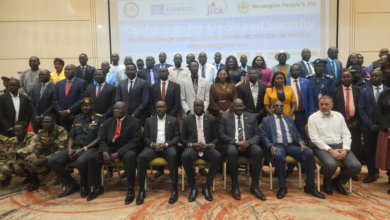
The Ministry of Information, Communication Technology and Postal Services on Tuesday launched a three-day Media and Security Conference in Juba aimed at strengthening cooperation between journalists and security institutions ahead of South Sudan’s anticipated elections.
The conference, organized with support from UNESCO and the Japan International Cooperation Agency (JICA), is being held under the theme: “Shaping a Future at Peace: Promoting Press Freedom, Human Rights and Development through Elections.”
The gathering brought together journalists, security officials, civil society representatives and international partners to discuss media safety, election reporting, misinformation, artificial intelligence and digital governance.
Speaking during the opening ceremony, Ateny Wek Ateny said press freedom remains essential for peace-building, accountability and democratic development in South Sudan.
“It is my honour and privilege to join you today in commemorating the World Press Freedom Day 2026, Ateny said. “A free, responsible and professional media is not an enemy of the state. Rather, it is an important partner in nation-building.
He emphasized that freedom of expression and press freedom are constitutional rights that must be protected within the framework of the law, adding that the relationship between journalists and security institutions should be based on cooperation, dialogue and mutual respect instead of fear and mistrust.
According to Ateny, journalists and security institutions play complementary roles in society, especially during elections and periods of national importance.
“When you look at this, you find the media and the security are two different sides of the same coin,” he said. “None can operate without the other.”
The minister noted that investigative journalism often supports the work of security agencies by exposing wrongdoing and uncovering critical information.
He also urged state authorities to organize similar workshops across the country to improve understanding between journalists and security personnel.
If there is a difference between journalists and the security organs, then it is a misunderstanding, Ateny stated. “Journalists are there to expose weaknesses, but that does not make them enemies.”
Meanwhile, Abdul Wadood warned that global press freedom continues to face growing threats amid technological and political changes.
“Freedom of expression has declined globally by 10 percent since 2012, and there has been a 48 percent increase in efforts to control or restrict media,” Wadood said, citing UNESCO data.
He stressed that journalism remains vital in promoting peace, accountability and public trust.
In an age where information itself has become a carrier of power and governance, its capacity to uphold facts and foster understanding determines whether society chooses cooperation over confrontation,” he said.
Wadood further highlighted the growing influence of artificial intelligence and digital platforms, warning that while technology can expand access to information, it can also fuel disinformation, manipulation and online abuse.
“Press freedom in the digital age must remain protected, inclusive and accessible to all,” he added.
On his part, Sapana Abui, the Director General of Information and Compliance at Media Authority said improving relations between media and security institutions is critical for democratic progress and peaceful elections.
He revealed that South Sudan lost points in the global press freedom index largely due to security-related challenges affecting journalists and media houses.
“Media and security have concurrent but often conflicting roles in building a democratic nation. The media provides credible information to the public, while security institutions focus on protecting classified information and national stability,” Sapana said.
He condemned harassment, intimidation and illegal closure of media houses, describing such actions as unconstitutional.
“Safety of journalists from harassment, unwarranted intimidation, arrest and illegal closure of media houses are unconstitutional practices,” the Director General added.
He also called on journalists to uphold professionalism, accuracy and impartiality, particularly during election reporting.
“It is the responsibility of the media to ensure that voters are educated accurately on all election procedures,” he noted.
The conference comes as South Sudan continues preparations for its long-awaited elections amid ongoing calls for peaceful democratic transition, institutional reforms and protection of civic freedoms.