Women struggle to rise from ruins of Fangak floods
Warning: Undefined array key 0 in /home2/cityrevi/public_html/wp-content/themes/_city/single.php on line 65
The floodwaters that wreaked havoc on Unity and Upper Nile states have not yet retreated and resumed normal life to earning a living remains difficult for thousands of people.
Women are still struggling to sustain their families and re-establish their livelihoods daily. As months pass by, the trauma and economic agony continue to linger. Floods have damaged farmlands, homes, drained crops, caused erosion, killed cattle, and washed out roads and bridges across much of Jonglei state.
While the victims of the flood disaster are still recovering, some are concerned that changing global weather patterns will result in additional flooding.
The City Review visited Fangak County in October 2021, in South Sudan’s Jonglei State, and spoke to women like Nyatident (not her real name) who have lost farmlands, livestock, homes and now live in constant fear of recurring floods.
However, it is now one month but the situation in the area has not improved. To add more misery, the local authorities have raised concerns over the unknown disease that has so far killed 89 people in the area.
“We had enough food by then, but today we don’t have enough food,” Nyatident said.
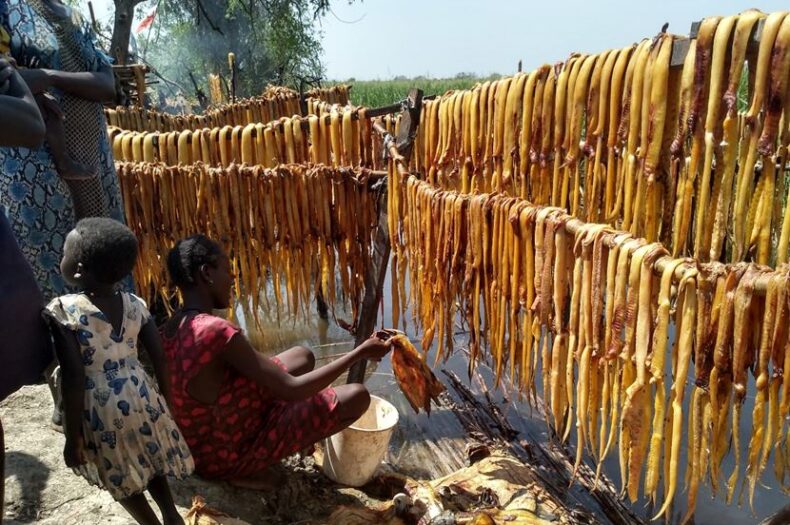
“The only meals we are having are water lilies which we get from the river. Sometimes we do fishing, but when you lose a fishing net, that means that you will have not to fish. We come and dry up the water lilies and then we start grinding it so that that is the source of food.”
Like Nyatident who struggles to put food on the table, The City Review spoke to Ngate Yawa, a mother of four whose livelihood as a farmer was devastated by floods. She lost her entire farmland to water.
“We started to harvest in August and then the floods came. I just started taking my children out of the area where it was safe. Then everything was taken by water. I lost land then I lost money, “Yawa explained.
Damaged infrastructure
It is not just the loss of land that has affected the women, but also the roads leading to major health clinics and schools have been cut off healthcare inaccessible. Hundreds of children are also out of school.
“When someone falls sick, especially the children, we use the boat for taking them to the hospital. When they get medication then we come back.
“This is the means of transportation we are using here in Fangak County. We don’t have roads like in the other places,” she said.
Mabior, a mother of two, said although life had been difficult for the past two years of flooding in Old Fangak, she had been fishing to make ends meet.
“Besides collecting lily flowers for feeding my family, I also do fishing to feed my children and besides that, I try to take the fish to the market for sell so that I can buy salt, soap and sometimes even medicine for treating my children,” she explained
In South Sudan, UNHCR estimates that close to 800,000 people have been affected by rising waters across the country since May 2021 to date. The affected areas are Jonglei, Unity, and Upper Nile states.
IOM chief of mission in South Sudan, Peter Van Der Auwersert, said a long-term solution to the flooding problem in the country required urgent action.
“What we are seeing today [is] climate change in action. How can we in the future as a country and a region manage the water of the Nile better so that we don’t have this further flooding? he posed.
Floods have affected thousands of women across South Sudan, adding it had become a women’s crisis.