Returnees in Magwi appeal for farm tools

The returnees in Agoro payam, Magwi County, have appealed to the UN High Commission for Refugees (UNHCR) to provide them with farm tools to produce their food.
This comes after the UNHCR special envoy for the Horn of Africa, who also serves as the UNHCR’s ambassador to IGAD, assessed the situation of returnees in the area last Saturday.
David Wani, a youth leader in Agoro, who spoke on behalf of the returnees and the host community, provided a list of issues they encountered as well as what they want the UNHCR to do to help them rebuild their lives.
“Help us in some parts, like education, roads, health, agriculture, training to give us awareness of other things and the issue of cattle,” he said.
Okenyi Charles, the head chief of Agoro Payam, who is also one of the returnees from Uganda, pleaded with the delegation to provide them with agricultural requirements such as tractors, seeds, hoes, pangas, and axes to aid in cultivation.
“There is no road to transport all these things, so our road needs renovation,” he said.
The commissioner of Magwi County, Otto David Remson, also appealed to the UNHCR visiting delegation to assist returnees and the host community in improving their lives.
The returnees told the UNHCR team on Saturday that the biggest challenge they have continued to face since their return is the presence of cattle roaming around.
They said it was endangering agriculture as herders graze their cattle on farmland.
According to the commissioner, Otto, about 10 households had remained in the area since the onset of the war in 2013.
He appealed to the UN delegation to assist the community with income-generating activities such as livestock to vulnerable groups, youth capacity building, and cooperative groups with modern agriculture instruments to promote self-sufficiency.
As the entire community of Magwi County is returning home, the returnees face challenges of water, education, health, roads, food, shelter, and now the presence of cattle in the area.
Mr. Otto said between January 2021 and January 2022, approximately 82,072 people returned to Magwi County from refugee camps.
“Your continuous support for the community of Magwi County will not go unnoticed, but [we] will be remembered and appreciated,” Otto said in a letter read to the UNHCR delegation
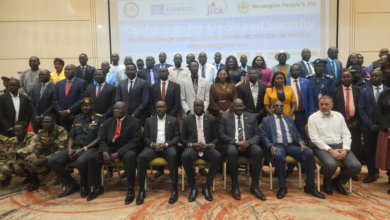
Ambassador Mohamed Affey, the UNHCR’s special envoy to IGAD and the Horn of Africa, said his visit to Magwi County was to encourage the returnees and provide community support.
“We can only come and see the challenges that you face in terms of people who are returning. People would not return if there was war and difficulty. People are returning because this is their home and they are returning because they have confidence in you- the people who are leading this country to provide the environment for them to return,” he said.
“We have an obligation as an international community to assist you. To create better conditions. We say now roads, health, schools, livelihood opportunities so that the youth can find what to do.”
Ambassador Affey also visited the health facility and Magwi Secondary School, as well as Agoro, where the majority of returnees have resettled and engaged in extensive cooperative farming with UNHCR support.
According to a report by development partners, some 400,000 South Sudanese refugees have returned to their villages from neighbouring countries in a self-organised manner.
Eastern Equatoria (99,000), Unity (75, 000), Central Equatoria (59, 000), Jonglei (27, 000), and the Upper Nile have the highest return rates (53,000). The bulk of people in East Equatoria have returned to Magwi County, where they have begun to rebuild their lives.
According to the RRC, UNHCR and humanitarian partners monitoring returns, the highest return locations in Eastern Equatoria include Magwi, Torit, Lafon, Ikotos, Budi, Kapoeta North, East, and South.
Challenges
Returnees encounter a variety of socioeconomic and security situations across the state, which has impacted their chances of reintegration.
Magwii County has received around 53,000 South Sudanese refugees out of 400,000 spontaneous returns to South Sudan from neighbouring countries during 2018. As a result, the area has one of the highest concentrations of returnees in South Sudan.
Majority of returnees are resettling in their new homes and reintegrating into at least six of the county’s eight Payams, despite gaps in basic amenities, livelihood options, and poor road infrastructure.
Since 2019, the payams of Iwire, Magwi, Obbo, Pajok, Lobone, and Agoro have been reasonably peaceful, with communities beginning to rebuild their lives through agricultural efforts.