Long route that landed COVID vaccine in Juba
Warning: Undefined array key 0 in /home2/cityrevi/public_html/wp-content/themes/_city/single.php on line 65
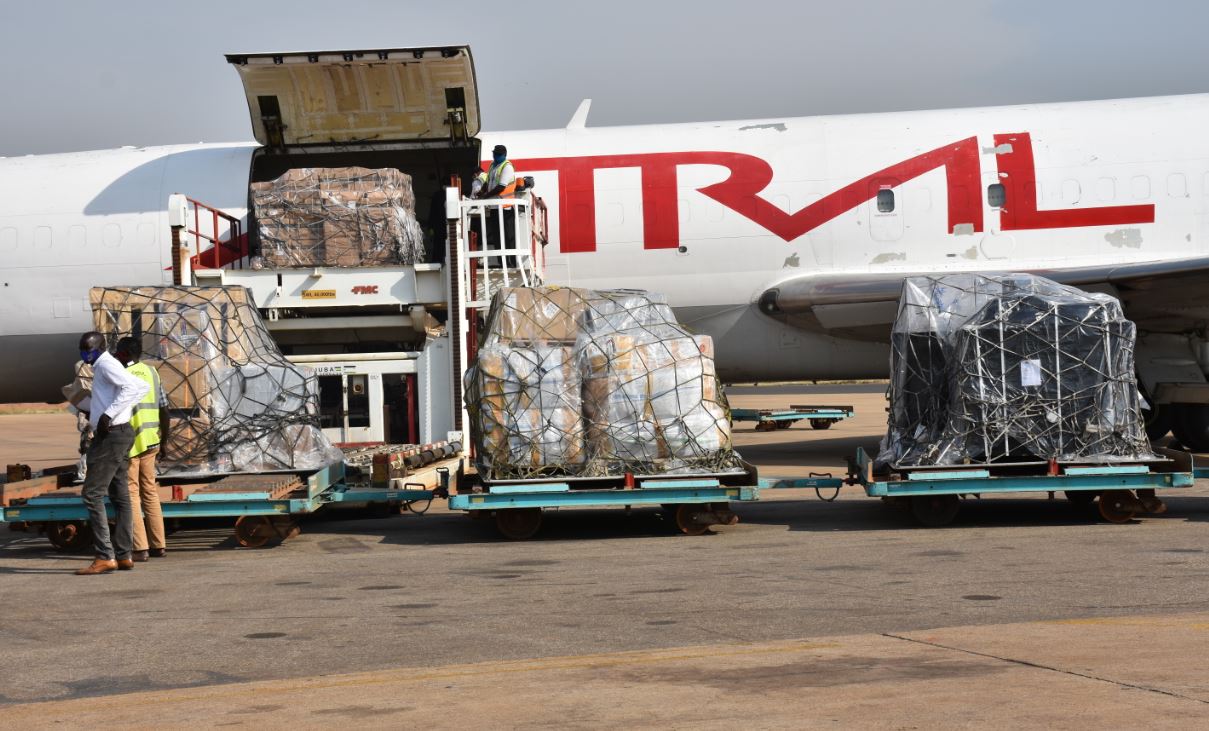
A white 5Y-MWM plane belonging to Astral Aviation landed at the Juba International Airport on March 25, Thursday morning. Its nose had a writing ‘We Shall Overcome’, relaying the message of solidarity for a course to defeat the coronavirus.
The plane carried 132,000 doses of AstraZeneca COVID-19 vaccines the country eyes to use for the first phase of the inoculation.
On the ground was a contingent of government officers led by the Minister of Health Elizabeth Achuei and the Chairperson of NTC and Presidential Security Advisor Gen Tut Gatluak who were on standby for the landmark event. It was now time to relieve the anxiety and to roll out the vaccination program to beat the aggressive virus.
Even though the government now has the opportunity to employ the use of the vaccine, its arrival in the country involved certain hits and misses, and even long waits that put the health officers in their heels.
Bid for jab
The journey for the vaccine came public when the Director of Emergency Preparedness and Response Dr Angelo Thon told the media in December 2020 that South Sudan was destined to be one of the recipients of the vaccine courtesy of United Nations Children Fund (UNICEF), World Health Organization (WHO) and the Ministry of Health.
“We will know how many doses are there for each African country and South Sudan will claim its doses and then WHO and UNICEF Would help to transport these vaccines from Europe to South Sudan,” he said.
Dr Thon did not reveal the type of vaccine the country would expect because many trials were on course as countries jostled for their best inoculation approaches.
World Health Organization’s Emergencies Program Manager Wamala Joseph also revealed that WHO was doing the approval trials and that COVAX Facility had promised African countries a vaccine each to cover for their 20 per cent population.
On January 27, the Director General for Preventive Health Service Dr John Romunu addressed the journalists and this time it was even more positive news. The government had requested for five million doses to inoculate 20 per cent of the population. The doses were to be gotten through Global Alliance for Vaccine and Immunization (GAVI).
Dr Romunu said logistical arrangements were underway because the ministry was factoring in the fact that it would take three months to acquire the vaccines.
Things change
But in slightly less than a month later, on February 23, the tune changed. This time, officials from WHO and the health ministry called for a press conference which was partly held virtually, and they said the country would now receive 35 to 40 per cent of the 864, 000 doses that had been assigned in latest amendment.
This meant that the country would receive approximately 300,000 doses for the start.
“We have been given indications that 35 to 40 per cent of the 864,000 dozen will be in the first charge and subsequently that the reminder would come at a later point,” Dinceen Brendan, Coordinator of COVAX Facility.
Dr Romunu further exuded confidence as he emphasised that the South Sudan had gotten the much required approval.
“We are happy to tell you that we received positive feedback from the COVAX facility and we are waiting for further guidance and the most important thing is that the vaccine has been approved,” he said.
The country’s fight with the virus weakened at the time as cases became alarming. For instance, analysis by The City Review in early March revealed that South Sudan had registered slightly 3,000 cases in entire 2020, but come 2021; the cases had increased by 3,663 in just a span of two months. This translated into 1,800 cases a month in 2021, up from 388 average cases a month in 2020.
March 2021 came with more expectations for the arrival of the vaccine but there were no indications in sight.
It turned grimmer on March 11 when Dr Thon revealed in a local radio station that the country would wait for longer due to logistical hitches.
“We were supposed to have the vaccine in the country by mid-February, [there has been lack of] logistical procedures [which involves] shipping it to the country to make sure the arrangement is done,’’ Dr. Thon said.
Eleven days later, the country would be treated to another shocking late cancellation worth an April Fool’s Day gimmick.
A consignment of the COVID-19 jab—courtesy of Africa Centre for Disease Control and Prevention, MTN, and the African Development Bank—which was expected to land in Juba on Monday, March 22, had just been cancelled.
COVID-19 Incident Manager told the City Review via a phone call that there was no official communication about the arrival. Another concealed source from the ministry of health attributed the cancellation to lack of logistical arrangements but the whole event sounded mysterious.
“We have not yet received an official communication concerning the arrival of the vaccine. If there was anything positive to that effect, we would have received communication.
“Most probably, the vaccine could arrive on Tuesday,” said Dr. Lako.
The 132,000 doses that landed in South Sudan alongside 132,500 syringes and 1,325 safety boxes are part of the 732,000 doses set to be administered in six months.
The government targets frontline health workers and those with pre-existing health conditions in the first phase.