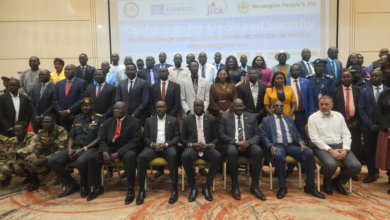
AU-EU ministerial meeting kicks off in Kigali
Warning: Undefined array key 0 in /home2/cityrevi/public_html/wp-content/themes/_city/single.php on line 65

The African Union and European Union ministerial meeting kicked off in Kigali, Rwanda, yesterday.
The second-ever ministerial meeting was attended by 500 participants, among them 60 foreign ministers of the European and the African Union, the Rwandese media revealed.
This is the first time the meeting has been held since the start of COVID-19 in Africa. The meeting was first scheduled to take place in May 2020 but was halted by the COVID-19 restrictions.
The Minister of Foreign Affairs and International Cooperation Mayiik Ayii Deng who travelled to Kigali on Sunday for the two-day meeting is representing South Sudan in the meeting.
According to the office of the Ministry of Foreign Affairs, the attendees will deliberate on how the African Union and the European Union can strengthen resilience, peace, security, governance, migration and mobility.
Agenda
They also look at the mobilisation of investments for African infrastructural sustainable transformation and investing in education, science, technology, and skills development.
Yesterday, during the opening day, both the EU and AU representatives vowed to continue mutually supporting each other for the future of the two continents.
They promised to strengthen cooperation through principles of equality and mutual benefits.
The meeting is also a curtain-raiser for the AU-EU summit scheduled to take place in Brussels next year. However, a joint communique would be adopted by the ministers of foreign affairs in this meeting.
Joint Communique
In the previous one, the foreign affairs ministers belonging to the two regional blocs held a meeting in Brussels, Germany between January 21, and 22, 2019 and issued a joint communique.
They stressed cooperation and addressing common challenges jointly.
They reiterated their common interest and opportunity for a strong and mutual partnership that would be beneficial through shared ownership, responsibility, reciprocity and mutual accountability and transparency.
They also focused on curbing the illicit financial flows, tax avoidance and rampant corruption that deny member states revenue through leakages.
The ministers reiterated the need to achieve a better labour force which was agreed in the Abidjan declaration at a summit held in Abidjan, Ivory Coast on November, 29 and 30, 2017.
Abidjan declaration
The Abidjan declaration (4th Africa-Europe Youth Summit) attended by 36 young people from both continents was held on October 11, 2017.
The Abidjan declaration was a youth agenda to be presented at the summit which contained six priorities.
The six priorities which were agreed upon were: education and skills, business, job creation and entrepreneurship, governance and political inclusion, peace and security, culture, sports and arts, and the environment and climate change.
Further deliberations
In the fifth summit of the AU-EU, conducted on November 30, in Abidjan, Ivory Coast, the two partners focused on economic opportunities for youth, peace, and security, mobility and migration and cooperation on governance.
African and EU leaders focused on investing in youth placing a key priority for Africa and the EU as 60 per cent of the African population is under the age of 25.
The new EU external investment plan which was presented to leaders at the summit intended to allocate 44 billion Euros for investment in Africa by 2020.
This was to be purposely for the creation of jobs for young people across the African continent.
European Union and African leaders accepted to commit themselves to end the inhuman treatment of migrants and refugees in Libya.
A statement from the partner blocs read: “Libya with the most cynical abuse of human beings. Let me repeat my call to impose UN sanctions on human smugglers and traffickers.
“And let me also say that we will not be effective if we do not ensure that the people caught up in Libya and elsewhere can return safely to their homes.”