SSCSE candidates shine against COVID-19 odds
Warning: Undefined array key 0 in /home2/cityrevi/public_html/wp-content/themes/_city/single.php on line 65
By Mamer Abraham
Joseph Obwany Okic Nyikang from Joseph Okwaci Secondary School in Upper Nile is the best candidate in the 2020 Certificate of Secondary Education Examinations.
The results were announced by the Minister for General Education and Instruction in Juba yesterday.
Nyikang was named the leading student nationwide with a mean score of 95.1 percent.
He was followed by Sebit Justin Sunday Lavirick from St. Comboni Secondary School of Central Equatoria State who had a 94.6 percent mean score while Chiok Otong Liah Chieh from Juba International Secondary School, Central Equatoria State came third with the mean score of 94.4 percent.
Kiir Kiir Aluetmiir Kiir from Darling Wisdom Academy, Central Equatoria State was in fourth with the same mean score of 94.4 percent. Deng Chol Deng Chol came from Bor College High School in Jonglei State closed the chart of the five best candidates with a mean score of 94.1 percent.
The males dominated the top ten slot with only three females—Anna Jumbo Lado Tombe (Juba Diocesan Model) and Elizabeth Luis Mayar Diocesan Model) and Josephine Gwido St. Daniel Comboni—making the cut.
In the girls’ category, Josephine Poni Gwido Swaka from St. Daniel Comboni Secondary School, Central Equatoria topped with a 93.9 per cent mean grade, followed by Anna Jumbo Lado Tombe from Juba Diocesan Model Secondary School, Central Equatoria State with a 93.6 percent mean score, and Elizabeth Achuil Luis Mayar from Juba Diocesan Model Secondary School, Central Equatoria State with 93.4 percent mean score.
Girls shine
As per the results, the female candidates have performed more than male candidates. Out of a total of 870 students which is 2.6 per cent of all the candidates who failed the examination, 586 were males and whereas 284 were females-a difference of 302 students.
Eastern Equatoria tops
In the state ranking, the Eastern Equatoria State has been declared the best performing region with a total of 2001 candidates who sat for the examination. The state had the highest performance index nationwide of 79.96 percent. Jonglei State came second with 2063 registered candidates and 78.11 percent performance index while Central Equatoria State came in the third position with 12,792 registered candidates and 77.40 percent performance index.
Ruweng Administrative Area occupied the fourth position having registered 906 candidates with a performance index of 76.63 percent which was the leading Administrative Area.
There was also a greater emphasis on the performance of girls between 2019 and 2020 where female candidates are noticed to have an increased performance. The males shot up 97.3 percent in 2020 compared to 92.1 percent in 2019.
Girls improved in their performance too in 2020 registering 97.5 percent unlike in 2019 which they had a 93.2 per cent-an increment of 4.3 percent in the year 2020.
This data shows that more females registered for the commercial section more than males while more male candidates than female candidates registered for the academic section and technical section.
The minister revealed that the candidature had been increasing in the last eight years from 2013 to 2020 with an increment of 6,565 registered students in the year 2020 examinations. This is despite the fears expressed by the stakeholders that COVID-19 impacts worked against the privileges of the girlchild by leading to early pregnancies and forced marriages.
Drawbacks
The absenteeism from examination had also been noticed to have been increasing since 2013-2020 with an increment of 617 from 2013-2020.
The passing rate of the students is noted to have been increasing over the last eight years with the passing rate in 2020 being 97.4 per cent compared to the year 2019 which was 92.5 percent. It shows an improvement of 4.9 percent between the two consecutive years.
However, it remained standard between 75 percent and 90 percent which the examination council would want to maintain in future examinations.
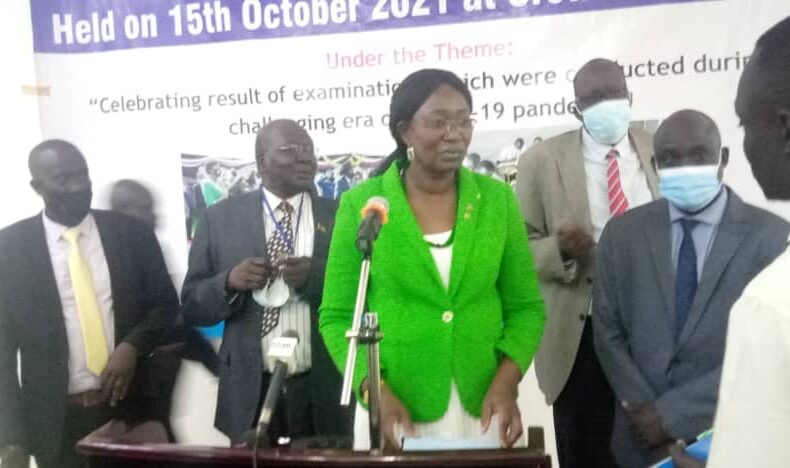
While announcing the result, Minister of General Education and Instruction Awut Deng Acuil directed the states to pick the results from the State Secretariat to be delivered to their respective states and schools.
“I hereby now officially release the 2020 Secondary School Examination results. Members of the public are advised to obtain the official results from the schools where the learners last wrote their examination. States areas coordinated can pick copies of the results for their states and Administrative areas at the secretariat of examination premises,” she said.
Awut congratulated the successful candidates for the 2020 examinations.
She acknowledged the work of the security organs and the police for their provision of security in the States at the examination times.
The minister expected the number of candidates to increase to 45,000 candidates in the academic year 2021 as there has been an increasing number of candidates sitting for senior four exams over the last eight years.
It was noted that the number of male candidates enrolled in the 2020 exams was higher than that of the females.
There was also a concern about the number of absentees which had increased from 558 in 2019 to 617 in 2020 examinations.
According to the comment from the examination council, there was improved performance in 2020 from 92.5 per cent in 2019 to 97.4 percent which was said to be due to the efforts of the government and development partners in improving teachers’ incentives and the introduction of distance learning program during the closure of schools.
There were reported death of a student during the exams, results of 40 students were withheld due to inconsistencies, 627 candidates did not do exams due to their absence and 870 candidates failed the exams.
It was recommended that the National Government and education partners should endeavour to strengthen supporting girls’ education in secondary schools to encourage them to attain higher learning institutions.
The team recommended that there should be training for the examination managers, examinations to be monitored and briefed.
South Sudan launched its first-ever curriculum on September 9, 2015, with support from the Global Partnership for Education, UNICEF and the Department for International Development.