Haysom warns against “dangerous” snail pace peace process
Warning: Undefined array key 0 in /home2/cityrevi/public_html/wp-content/themes/_city/single.php on line 65

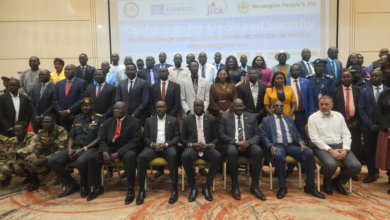
The Special Representative of the UN Secretary-General to South Sudan, Nicholas Haysom, has told the UN Security Council that the snail pace of the South Sudan peace process is roiling the progress.
In his address to the UNSC in New York, Nicholas said the steps taken towards the implementation of the Revitalised Agreement on the Resolution of Conflict in South Sudan (R-ARCSS) were insufficient to attain viable peace.
“Mr. President, the steps are taken so far in the implementation of the revitalised peace agreement are welcomed. However, they are not sufficient in the momentum to realise peace is to be sustained,” Haysom said during his briefing to the UNSC in New York.
He highlighted the security implementation chapter as the crucial area that is still causing divisions among the partners.
“The failure of the parties to reach an agreement on command ratios have fomented a fracturing of the SPLM/A-IO and since my last briefing, mediation efforts that began in Khartoum seeking to bridge the divide on Chapter Two issues and to heal the SPLM/A-IO split with its Kit Gwang Faction have been undermined by the political crisis in Sudan.”
However, he commended the government for releasing the budget for the screening of the unified forces. He also applauded the decision to reactivate the Sant’Egidio peace talks with the holdout group to ensure a viable peace.
“I welcome the government’s decision of November 20, 2021, to rejoin the Sant’Egidio process and encourage the holdout groups, especially the National Salvation Front (NAS), to join the process without any precondition,” Nicholas stated.
“I am happy to announce that after our meeting (with President Kiir), the Joint Defense Board (JDB) announced progress (that) funds have been released for screening soldiers at training centres preliminary to graduation of unified forces,” he said.
“Delivery of foods and medicines have also commenced. This is an eminent step in the complex but essential process of constructing a national army, one that is a symbol and a mirror of the unity of its people.”
The UNMISS chief recommended that efforts should be intensified towards the forthcoming elections. He added that observing the constitution was vital as he noted that the civic space remained of great concern.
Election puzzle
Haysom once again warned against speculating about holding an election when there are inadequate preparations.
“The President has announced that elections will be held in 2023, while I note that members of the presidency are yet to coalesce around an electoral timetable. “The next year presents a dramatic challenge if South Sudan is to complete its transition,” he said.
“It will require technical and political preparations, including an agreement on the constitution, as well as the rules governing the elections.”
He urged the government to lift restrictions on civil space to allow for peaceful demonstrations as well as protection of the fundamental rights of citizens.
According to the Director of the Coordination Division in the Office for the Coordination of Humanitarian Affairs, Wafaa Saeed, South Sudan has recorded the highest levels of food insecurity since 2011 and since the onset of the renewed conflict in 2013.
According to Saeed, approximately 7.2 million people were affected by the crisis, with 2.4 million of them “in the emergency phase.”
Blames on embargo refuted
In his speech, the UN Ambassador to the United Kingdom, James Kariuki, warned that the “snail pace” of the peace agreement had real and grave consequences for the people of South Sudan. He urged South Sudanese leaders to step up their efforts in the coming year, 2022.
“We recognise the challenges, but this lack of progress has real and grave consequences for the people of South Sudan.” “The United Kingdom joins others in calling for South Sudan’s leaders to redouble their efforts in 2022,” said Kariuki.
Kariuki commended the government of South Sudan for its strides towards public financial management through collaboration with the international community and urged the government to approve the “delayed annual budget.”
He said that fighting graft by ensuring transparency and accountability could lead to an improvement in livelihoods and attract international investors.
“The UK is also pleased that the graduation of the necessary unified forces is imminent. We do, however, refute the argument that the arms embargo was responsible for the lengthy delays in graduating the necessary unified forces,” said Kariuki.
“The exemption procedure remains in place to ensure the embargo does not constitute an obstacle to South Sudan’s legitimate security needs,” he said.
Kariuki called for an end to restrictions on freedom of speech and association, as well as perpetuating sexual gender-based violence (SGBV).
Embargo hamper peace process
In his meeting with UNMISS Chief Nicholas Haysom on December 8, President Salva Kiir blamed the slow implementation of the revitalised peace agreement on the arms embargo imposed on the country by the UNSC.
This was the third time the president had raised this concern after he presented the same concern during his previous meeting with the IMF chief and also the visiting delegation of the United Nations Security Council to Juba last month.
Kiir said the lifting of sanctions would pave the way for the smooth running of the peace process to completion.