Persons with disabilities call for equal representation
Warning: Undefined array key 0 in /home2/cityrevi/public_html/wp-content/themes/_city/single.php on line 65
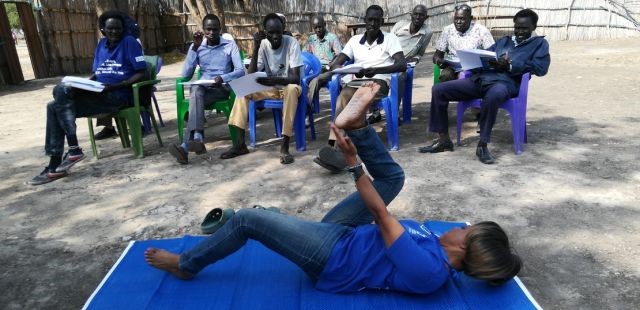
People with disabilities are advocating for inclusion at all levels of government to enable them to participate in decision-making at all levels of governance.
Augustino Wue Ilario, the Chairperson of the Union of Persons with Disabilities, who is also visually impaired, told The City Review on Friday that the International Day of Persons with Disabilities provides a platform for them to interact with stakeholders and key government officials to express their concerns and challenges.
He said the adoption of the United Nations Convention on the Rights of Persons with Disabilities, would be an essential text and a crucial instrument that protects people with disabilities.
Augustino said it is one of the primary messages people with disabilities would like to communicate on this day.
“This document is not yet ratified, so this is one of the messages that we are passing to the government,” he told The City Review in an interview.
Augustino stated that the union has been advocating for the government to designate 15 affirmative action representations for persons with disabilities in all organs of government, which they have not yet achieved.
Grievances raised
“Our women with disabilities need to benefit from the 35 per cent affirmative action allocated to women in South Sudan,” Augustino emphasised.
He emphasised that given the current economic constraints, the majority of individuals with disabilities are trapped in extreme poverty, with no access to better services such as education, medical care, and other necessities.
To address all of the issues that people with disabilities face, he believes that they need representation at all levels of government so that they may have a say in how decisions are made.
Only a few people with disabilities who have earned diplomas or bachelor’s degrees work in the ministries of education and gender equality, says Augustino.
He attributed it to negative attitudes toward people with impairments, adding that people with disabilities are often not employed in government institutions.
“They are meant to be employed based on their credentials and faculties, but the problem is that people do not recognize or value people with disabilities,’’ he said.
Mary Sabuni urged the government to include a world day for people with disabilities on the national calendar to recognise their accomplishments and contributions to society’s advancement.
‘‘Although it is an international day, there are no official holidays; only the Ministry of Gender, Child, and Family Affairs observes it.
“We want the government to include us in their December 3 public holy day so that people will know that there are people with disabilities in South Sudan,” Sabuni said.
According to Sabuni, people with disabilities, particularly women, are denied the majority of their rights. They are not taken to school, and they are occasionally sent out into the streets to collect money for the family. As a result, she claims, they become pregnant, resulting in double disability.
“Instead of contributing to the family’s money, she returns with a baby.” The majority of women with disabilities are single mothers, and they are all brought to them by their families, who are uninterested in women with disabilities,” she said.
Sabuni said women with disabilities do not have access to work, which is a challenge that all people with disabilities experience, as well as access to education.
“On the side of the blind, there is only one school of the blind at Rajaf, and we apply for employment, attend interviews, and pass the test. Later, they say we want people who are physically fit and that the offices have steps you cannot climb. This is what bothers us much. ” Sabuni said.
She said women with disabilities are not beneficiaries of the 35 per cent affirmative action given to women to participate in the decision-making process because they are not members of any political party in the country since appointment in political positions is restricted along party lines.
Women with disabilities, she claims, are ineligible for the country’s 35 per cent affirmative action for women to participate in decision-making because they are not members of any political party, and political appointments are confined along party lines.
“Women with impairments are the ones who don’t understand the parties, which is why they didn’t get their fair share.” She urged.
Sabuni urged educated women with disabilities to join political parties that reflect their interests in order to take advantage of the 35 per cent affirmative action policy.
She also urged families of disabled women to provide them with an equal opportunity to attend school rather than keep them at home.
“Let the government pay attention to disabled women, even if it means establishing adult education for them, starting with primary school, so they can grasp what is going on,” said Sabuni.
Rufas Loro Wani, a senior four student, stated that he has had a lot of trouble since he was in primary school.
One of the difficulties, he added, was that the school lacked a ramp or a wheelchair for him to use. The second issue, according to Loro, was his writing pace in class and on tests.
“I used to be carried to class by friends, and teachers would write quickly and rap on the chalkboard when I was still, and they wouldn’t allow me enough time on exams,” Loro explained.
Loro urged teachers to be considerate of students with impairments and not equate with physically abled students because they write more slowly than their peers with physical abilities.
He also encouraged the government to investigate putting ramps in schools to make it easier for pupils with limb problems to get around.