FAO waves red flag over soil salinisation
Warning: Undefined array key 0 in /home2/cityrevi/public_html/wp-content/themes/_city/single.php on line 65
Soil salinisation is a threat to food security worldwide, according to the Food and Agriculture Organisation of the United Nations (FAO).
FAO said many countries, especially those on the African continent, lack the adequate capacity for soil analysis.
Soil salinisation is the accumulation of soluble salts of sodium, magnesium, and calcium in the soil texture such that soil facility is severely reduced.
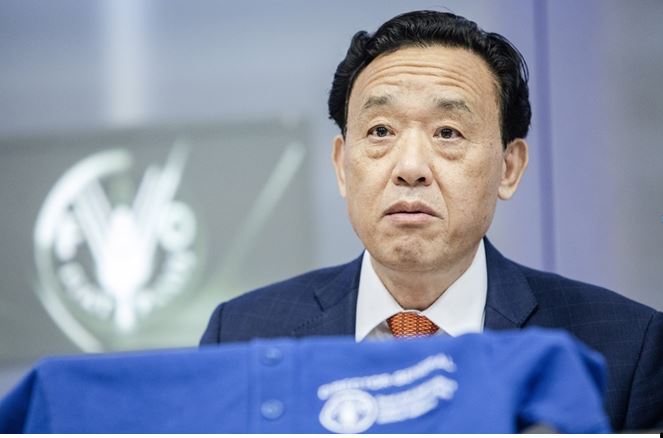
Food and Agriculture of the United Nations Director-General, Qu Dongyu (pictured), said that many countries globally lack the adequate capacity for soil analysis, and it is a threat to food security.
He said farmers depend on soil to produce about 95 per cent of the food people eat, and it’s the foundation of agriculture worldwide.
“Our soil is at risk. Now FAO called on all countries to urgently improve their soil information and capacities by making stronger commitments towards sustainable soil management, ” Dongyu said.
He made the remarks ahead of International World Soil Day in Italy’s Rome under the theme “Halt Soil Salinisation, Boost Soil Productivity.”
According to the FAO official, unsustainable agricultural practices, the overexploitation of natural resources and a growing population are putting increasing pressure on the soil and causing alarming rates of soil degradation worldwide. They said over 833 million hectares of soil worldwide are already salt-affected, as shown in the global salt-affected soil map launched by FAO in October 2021.
FAO also said that an estimate indicates that more than 10 per cent of arable land is affected, and it is a major risk to food security. Affected regions include Central Asia, the Middle East, South America, North Africa, and the Pacific.
Dongyu said the government or management of the salt-affected regions demands an integrated approach for the implementation of sustainable soil and irrigation.
He said there should be selected salt-tolerant crops and plants that can grow well in the affected salt area.
The report released by the FAO earlier this year indicated that 55 per cent of countries surveyed lacked adequate analytical capacities, including human resources, harmonisation procedures, and equipment. Many are unable to meet the national demand for soil analysis in Africa, Asia, and Eurasia.
Last month, the World Food Programme (WFP) and the United Nations Development Programme (UNDP) endorsed ways of improving food security within the country through an initiative dubbed “Ignite Food Systems Challenge.”.
Efforts to alleviate hunger
With the support of the USAID Bureau of Humanitarian Assistance (BHA), and the Ministry of Agriculture and Food Security (MAFS), WFP and UNDP have called for new ideas to end hunger, improve food security, and strengthen food systems.
The Ignite Food Systems Challenge that will be applied online will support South Sudanese entrepreneurs. The youth are required to pitch their businesses for financial and technical support through the challenge.
In October 2021, the United Nations Food and Agriculture Organisation has said South Sudan needs to produce 1.3 million metric tons of cereal to feed its citizens.
The common cereal crops grown in South Sudan include sorghum, maize, millet, rice, and wheat.
Deputy Country Representative of the United Nations Food and Agriculture Organization, Felix Dzvurumi, said the farmers are already producing about 800 tonnes of the crop.
In June 2021, the Food and Agriculture Organisation (FAO) and World Food Program (WFP) published a report stating that cereal production in South Sudan in 2020 rose by seven per cent compared to 2019 due to adequate rainfall.
But cereal production was said to be affected by prolonged conflict and floods in South Sudan by 2021 since most of the crops have been affected and millions left food insecure.
Cereal production in 2020 is expected to be 874,400 metric tons, a 7 per cent increase over the 818,500 metric tons produced in 2019.
In 2021, it is estimated that 465,600 metric tons will be produced as food insecurity remains high, with 1.3 million metric tons needed to feed the 12.2 million population.
Among the states that reported having a high cereal deficit were Jonglei, Unity, and Upper Nile states. FAO and WFP were said to be producing enough cereals to be purchased by FAO and WFP to feed the other nine states.