China’s war on poverty offers lessons for developing nations, including South Sudan
Warning: Undefined array key 0 in /home2/cityrevi/public_html/wp-content/themes/_city/single.php on line 65
Decades after the founding of the People’s Republic of China in 1949, millions of Chinese citizens faced food shortages and severe economic hardship. That has today changed astronomically
By Emmanuel Mandella
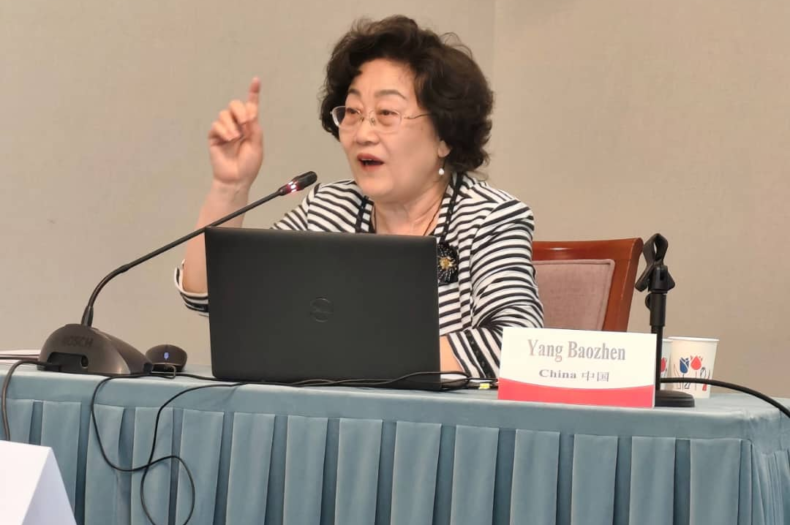
China’s remarkable journey from widespread poverty to becoming the world’s second-largest economy has been described as one of the greatest development transformations in modern history, with former Chinese diplomat and development expert Yang Baozhen saying the country’s poverty alleviation model could offer valuable lessons to developing nations, including South Sudan.
Speaking during a thematic lecture on China’s Poverty Alleviation Policies and Practices, Yang Baozhen former Chinese Consul in France and former Senior Program Officer at the Canadian International Development Agency — recounted China’s struggle with hunger, underdevelopment and economic hardship before the country launched reforms that eventually lifted hundreds of millions out of poverty.
“China used to be poorer than many African countries,” Yang told participants. “In 1978, China’s GDP per person was only 156 US dollars. At that time, many African countries had a higher GDP per capita than China.”
Yang, who worked as a diplomat in France and Gabon and later managed international development programs across China, said international cooperation played a significant role during the early stages of China’s development journey.
According to her, organizations such as the United Nations Development Programme (UNDP), alongside countries such as Canada, Germany, Japan and France, helped China introduce modern technologies, management systems and development ideas beginning in the late 1970s and 1980s.
“International assistance opened the vision of Chinese people,” she said. “It brought advanced technology, management experience and opportunities for Chinese officials to study abroad and understand global development.”
Yang explained that China’s poverty challenge was enormous due to its population of 1.4 billion people — roughly equivalent to the population of the entire African continent — combined with limited arable land and difficult geographical conditions.
“China has too many people and limited land,” she noted. “Thirteen percent of China is desert, and many areas are covered by mountains. Poverty alleviation in China was beyond imagination because of the scale.”
For decades after the founding of the People’s Republic of China in 1949, millions of Chinese citizens faced food shortages and severe economic hardship. Yang vividly recalled the ration coupon system introduced during the socialist planned economy era, where families received government-issued coupons to buy basic necessities such as food, sugar, meat and clothing.
“In those days, hunger was common,” she recalled. “Even buying peanuts during Chinese New Year was a luxury. We waited for holidays because that was the only time families could eat better food.”
The turning point came in 1978 when former Chinese leader Deng Xiaoping introduced the “Reform and Opening-Up” policy, shifting China toward market-oriented economic reforms.
Yang said the reforms first targeted rural communities, where farmers were allowed to manage their own land and profit from increased agricultural production.
“For the first time, farmers had motivation,” he explained. “If they worked harder and produced more, they could earn more money for their families.”
The reforms dramatically increased agricultural productivity, reduced hunger and laid the foundation for industrialization and urbanization.
China also established Special Economic Zones such as Shenzhen, a once-small fishing village near Hong Kong that has since grown into a global technology and manufacturing hub with millions of residents.
“Forty years ago Shenzhen was a poor fishing village,” Yang said. “Today it is one of China’s richest cities and home to some of the world’s leading technology companies.”
Yang highlighted that in February 2021, Chinese President Xi Jinping officially declared that China had eliminated extreme poverty after lifting nearly 770 million rural residents above the poverty line over four decades.
According to Yang, China’s poverty reduction accounted for more than 70 percent of global poverty reduction during the same period.
The achievement, she said, was recognized internationally, including by United Nations Secretary-General António Guterres, who praised China’s strategy as an important contribution to global sustainable development.
“China achieved the poverty eradication target ten years ahead of the UN 2030 Agenda,” Yang noted. “This is a great contribution not only for China but for global development.”
The speaker attributed the success to strong political commitment, long-term planning, accountability systems and targeted poverty alleviation programs.
Unlike many developing countries where poverty programs often suffer from weak implementation, Yang said China established dedicated poverty alleviation institutions from the national level down to villages and townships.
“Every level of government had responsibilities and targets,” she explained. “There was accountability and follow-up.”
She also stressed the importance of infrastructure development, including roads, railways and industrial zones, saying economic transformation could not happen without connectivity and investment.
China’s Belt and Road Initiative, he added, has extended some of these development experiences to Africa through infrastructure projects including highways and railways.
For South Sudan — one of the world’s youngest nations still battling poverty, underdevelopment and limited infrastructure — China’s experience presents both inspiration and practical lessons.
Like China in earlier decades, South Sudan faces challenges including inadequate infrastructure, rural poverty, unemployment and limited industrial development. However, experts say South Sudan possesses enormous agricultural potential and natural resources that could drive long-term growth if supported by effective governance and development planning.
Yang emphasized that poverty eradication requires strong institutions, consistent policies and investment in education, agriculture and infrastructure.
“Poverty reduction is not only about giving money,” he said. “You need planning, implementation, follow-up and development capacity.”
He also stressed the importance of food security, recalling how China transformed barren lands into productive farmland through irrigation, terracing and community labor.
For South Sudan, where agriculture remains largely underdeveloped despite vast fertile land, such experiences could offer important guidance.
Media practitioners attending the lecture noted that South Sudan could particularly benefit from adopting long-term development strategies instead of relying heavily on short-term humanitarian interventions.
China’s transformation, they observed, demonstrates how political commitment, infrastructure investment and economic reforms can gradually improve living standards even in countries once considered deeply impoverished.
As developing nations continue searching for sustainable development pathways, China’s poverty alleviation story is increasingly becoming a reference point in global discussions on economic transformation.
“China’s experience shows that change is possible,” Yang concluded. “If there is vision, leadership and commitment, poverty can be reduced and people’s lives can improve.”